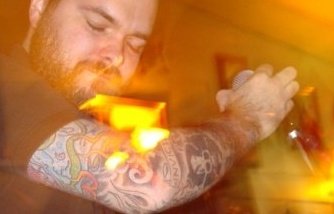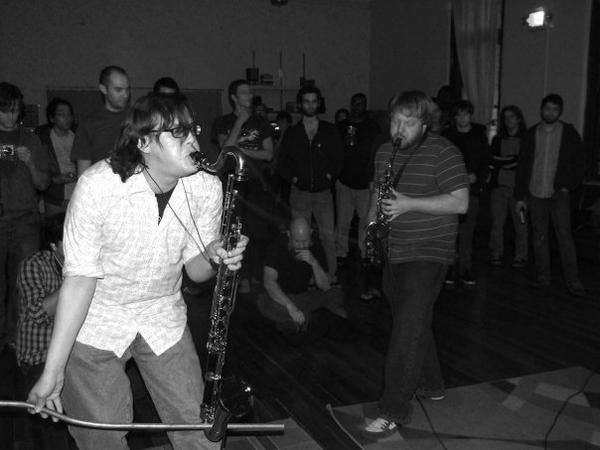
Interview with Wasteland Jazz Unit


Over the past two decades, I have had the pleasure of seeing many concerts of varying styles. Sonic Youth (Dirty era), at the time, was the loudest live experience for me. I was a teenager attending a Lollapalooza concert in Charlestown, WV when I first saw SY. Through the mountainous PA system, we all had our audible palate cleansed that night. Years later, I still remember a girl with her hands over her ears stumbling through the crowd away from the stage.


Then, one night, I saw two guys set up in an abandoned bank turned DIY space in Baltimore, MD. The setup seemed simple: two guys, two horns, a stack of amps each. A short greeting was followed by the loudest set I have ever heard. Even with earplugs, it was intense. Both flailed back and forth with intent like they were trying to force their lungs through their instruments. Wild combinations of notes and sounds, combined with feedback, left the faces (and ears) of the audience stunned.

Fifteen minutes into the set, one of their amps seemed to blow; leaving a constant ring like a heart monitor flatlining. The two stood facing eachother with their eyes closed. Even with amplification gone, Jon Lorenz continued to play acoustically. Jon Rich decided to riff around the feedback, as if it was part of the set. I was sold.

Listening to Wasteland Jazz Unit play, and the name itself, I feel like you guys would be the common "jazz" sound for post-apocolyptic times. How did you guys develop the style you play?

John Lorenz: Throwing contact mics in horns, turning our amps to 11, and an obsession with biting reeds and feedback tones. Not really going for post-apocolyptic or anything just playing the music we wanted to hear.

John Rich: No heads.

Do you do much in the way of manipulating your horns through effects pedals?

JL: None at all. The only effects we use are the ones already on our amps. Distortion, basically. Pedals can take away from the focus of things. We've heard a lot of jams completely ruined because of unnecessary effects. Either just awful sounds or too much focus on the "effects" than the sounds being created. Some people have this idea that "experimental music" is all about manipulating sounds but ya gotta make interesting sounds first, and then think about manipulating them. So yeah from the start we just said "Fuck using pedals" and focused more on the initial sounds we were making. I did just buy a volume pedal though so WJU officially has one pedal.

JR: No effects. Keep it simple, keep it raw.

How did you guys meet up, and start WJU?

JL: Me and John had met on several occasions over the years at shows and what not. At some point, we both figured out that we both played horns and were into free jazz and what not so it just made sense. John came up with the name before we even played together. When we first played together I showed John this idea that I had been messing around with using contact mics inside the horns and John said "yeah let's do that and turn our amps up all the way." So yeah it basically developed from that. I think our first show was in early April of 07 with Ryan Jewell and George Steeltoe Ensemble.

Do you guys come from any kind of a traditional jazz background?

JL: Not at all. I have no training what so ever. My sister was in band in high school and dropped out. She didn't need the sax anymore so I decided to take it back to college with me even though my parents wanted to sell it or something. They actually were kind of mad and wanted me to give it back but once they found out I was actually making "music" with it they were cool.

JR: I played clarinet in elementary and junior high band, but that's the extent of it. Don't really remember anything except how to blow "properly" but I guess that's all that really matters.

So, what kind of background do you guys come from?

JL: I started playing guitar when I was 13 or so. Started playing sax when I was 20 maybe. Grew up on Sonic Youth and Pavement and the typical 90's indie rock stuff. Got more into free jazz stuff when I started playing sax. Heard Brotzmann's "Machine Gun" and that pretty much explains everything.

JR: Can't remember... listened to a lot of Neil Young.

Live, you guys have a blistering sound; volume and chaos. What effect does your music have on you in a live setting? What impact are you hoping for on an audience?

JL: Our live sets are usually pretty chaotic but sometimes our sets change according to the room or the vibe. Live sets are fun cause people actually get to see the physical side of things so we try to play that up a bit more than we might on our recordings. We want it to be a physical experience. We want people to feel our hands hitting the keys, to feel our teeth vibrating against the reeds. That sort of thing.

JR: I just want to make people happy and enjoy themselves.

How do you identify yourselves, categorically? I've heard you described as "Noise Jazz," "Death Jazz," etc.

JL: I probably wouldn't even use the word "Jazz." I think we try to be as far away from the word "Jazz" as possible but that obviously comes with the territory of playing horns which is why we used it in our name. We might as well just play along. Yeah, we're a "Jazz" band.

JR: Death and noise make us sound so negative. I think of our music in a more positive way. Full of joy and happiness.

How often do you play in front of more traditional jazz crowds? You recently played a jazz fest in DC. What was the reaction like there?

JL: I think that was pretty much our first time playing for that type of crowd. In Cincinnati, we for the most part only play gigs that we put on. There isn't really much of a freaky jazz scene here. The New Atlantis Fest in DC was a lot of fun. I think we cleared at least half of the room but the people that stuck around we're very excited about what they heard. We didn't make it the first day but we heard the same thing happened for Weasel Walter's set with Darius Jones and Tom Blancarte. A good chunk of people didn't like it but the people that did like it really liked it and bought a lot of merch and stuff. I think to certain people in that "Jazz" scene bands with high energy are a breathe of fresh air.

JR: DC was a lot of fun. I never want to bum anyone out and we never really get asked to play jazz gigs in town. I think when people hear us they immediately know what they're getting into and will either stay or go. I guess it's nice to have a "yes or no" sound.

What is your involvement with the Art Damage Lodge? Will you give us a little background into the venue?

JL: We both run the space. We started it in October of '07. It's in an old Masonic Lodge. The name comes from the Art Damage radio show, which we now host, that was started here in Cincinnati, in 1985. The show was a big influence on us and has a lot to do with the history of experimental music in Cincinnati. We definitely wanted to keep that history alive and have our own place in Cincinnati to keep the weird music alive.

For those who don't know, Jon...you run the site Wounded Slug. Give us a little background on the site.

JL: Wounded Slug is a blog that I do that focuses on weird music of Cincinnati. I mainly post videos of shows at Art Damage Lodge and around town but I also post downloads to out of print records, old footage of stuff, weird Cincinnati related videos. I started the blog basically because when I moved here I would hear about these weird 80's Cincinnati bands like 11,000 Switches and BPA and what not and could never hear them. Our local record store ended up putting out a compilation of some of these weird Cincinnati bands so I finally got to hear a lot of them but there is still a lot of stuff that people don't even know about so I'm trying to put everything in one place so anyone who wants to know has a place to find these things.

Is Rub Don't Blot still operational?

JL: Yeah. I guess. We haven't put anything out on it in a while but the label kind of exists as a name for either of us to use for whatever we wanna do. I'm actually gonna start a more serious label to go along with the Wounded Slug blog. The first thing I have planned is releasing a series of double cassette boxes with each including four Cincinnati artists. There are a lot of people in Cincinnati that don't really put out music so I'm trying to collect a lot of these people with some other more active names for people outside of Cincinnati to hear.

Jon, I know you have Early Tunnels going on, outside of WJU. What are some other projects you guys have going?

JL: Yeah I have Early Tunnels that I do with Pete Fosco. Me and John are in a group called the Ohio Unsemble with Ryan Jewell, Jason Zeh, and Matthew Reis (Teeth Collection.) That is more focused on the quiet side of things. We also do Wasteland Jazz Ensemble occasionally which is us and various other members.

If someone hears you, and wants to know about other likeminded groups; what are some recommendations you make?

JL: Well, I think the obvious answer to this is Borbetomagus. Antoine Chessex's stuff is along the same lines.

JR: The Crystals, The Ronettes and Shirelles

WASTELAND JAZZ UNIT

Top 10 Albums of 2010

Of course, tastes and opinions vary.

1. Ghastly City Sleep "MOONDRIFTS"


Halfway through this album, I realized that there were a LOT of other indie/post-something-or-another/etc bands doing this type of thing that were in all of the popular music magazines; getting mainstream radioplay; making videos. The thing is...Ghastly City Sleep are doing this thing (whatever you want to call it) BETTER than those bands. There are so many layers to this album that truly make this one of the few music releases deserving of the adjective: EPIC. Somewhere, Radiohead, Deerhunter, and the like are sweating it.

2. LA Vampires meets Zola Jesus

This is one album that I have listened to a ridiculous amount of times. LA Vampires (ex-Pocahaunted) and Zola Jesus work together to create an after-hours, everyone is drunk and/or high, sweating, dancing, and the lighting comes straight out of the bar party scene in Fire Walk With Me. Dark, reverb drowning layering of vocals mixed with dub and ambience... I'm doing a horrible job at trying to describe this. This is the sound of two people meeting up and creating at the right time in their lives.

3. SLICES "Cruising"

When someone tells me about a band that I should check out, and they describe them as "punk" or "hardcore," I tend to forget about the recommendation and move on. For some reason I listened to Virginia based artist Sam Vanagas when he recommended the band SLICES. Thank you, Sam. There's a lot of bands doing this noisy, raw kind of mutation of punk (for lack of a better term), but SLICES completely blow me away. "Cruising" is the second most listened to album of the year for me. The closest thing to a modernized Black Flag that I've found.

4. Grinderman "2"

I am not a fan of Nick Cave's previous work. It has never really impressed me. Grinderman is the exception. "2" is a great marriage of noise-rock, blues, and even a touch of soul. Excellent songwriting. I had to make myself take it out of the stereo.

5. The Roots "How I Got Over"

In a year of weak beats, synths, and vocoder vocals trying to pass of as hip-hop, The Roots, with their full live band, showed everyone how things should be done: with heart and sincerity. Philadelphia's own knows exactly who they are, what they're strengths are, and they accentuate it to the fullest. Black Thought evens breaks out, stylistically, more with his quiet, gruff soulful crooning mixing in and out with the ebb and flow of headstrong lyricism and delivery that makes his world-reknown. Perfect album with the exception of the last two tracks.

6. Relay For Death "Birth of an Older, Much Uglier Christ"

What do you get when you take twin sisters, put them through a deprivation medical experiment, and let them take various objects, video footage, and recording equipment along for the ride? ANSWER: The best, creeped out sound/noise/experimental album of the year. This is the album I've been waiting for. Less look-at-all-of-the-equipment-I-have wanking; more original sense of creative direction.

7. Cut Chemist "Sound of the Police"

One DJ, some turntables, an encyclopedic library of vinyl spanning music from around the globe passed through a hip-hop filter; straight to tape. Even this doesn't sound like your thing, you'll end liking it, anyway. Good music is good music, regardless.

8. White Suns "Mourning Chamber"

Three guys from Brooklyn, NY destroying guitars, drums, mics, and you. Period.

9. US Christmas "Run Thick In The Night"

US Christmas expand their ever-changing lineup to include two drummers and a violin player this time around. USX have finally found the perfect balance between the faster, more raw material of early recordings, and the spacious, trip folk freakout of their last album, "Eat The Low Dogs." The clear, precise production of "Run Thick In The Night" allows the listener to finally hear every little nuance lost in the mix of previous albums, and the contributions of the new players added. Simply put, an impressive album.

10. Body Cop "s/t"

So, I had heard this buzz about a DC band called, Body Cop. Interesting name. Watched some live clips online, and decided to give the tape a listen. First couple of listens, I wasn't sure if I liked them, or if they were just another overhyped band. Then, I started reading the lyrics while listening to the album. Now, having listened to the album many, many times... I can honestly say that this is an intense album.

They claim a love for early-SWANS, but I don't like SWANS. However, Body Cop deliver something that is genuinely disturbing. The music is noisy, raw, and crushing; but not in a chugga-chugga metal fashion. It sounds more like a person's life is failing, and the vocals amplify this feeling. Even now, I still don't feel like I've picked up on everything there. I just hope that these guys and gal are completely sincere because it feels dead serious.


Interview with Andrew Aircraft


Andrew Aircraft is the man behind the curtain of noise project, Debris Amour, Swim Harder Cassettes, and the metal juggernaut, Moutheater. Below, Andrew shares some insight into his various projects.

Tell me about the origin or Debris Amour, Moutheater, and Swim Harder Cassettes.

Moutheater started out as Tim and I. I met Tim through his studio (Doubloe O). My old bands used to record there with him and long story short, we became friends and started working on music together. The initial concept for the band was for it to be the most aggressive elements of the 90's stuff that we both love combined with various other influences.

Swim Harder Cassettes started as a result of another cassette label offering to put out a Moutheater release. Things didn't pan out with that label so I decided to do it myself, this became the No Ballet ep and SHC's first release.


Debris Amour started as a result of my growing interest in "experimental" (for lack of a better all encompassing word) music over the past 6 or so years. I needed an outlet that allowed both pure sonic freedom and for me to somewhat step outside of the box of the guitar (which I've been playing for 16 years) and guitar oriented music.

Do each of your projects fulfill different needs from the other? If so, how?

Yes and no. They allow me to do different things and have a wide range of places for my ideas to go but at the same time I sort of look at them as all one big thing underneath the umbrella that is my creativity.

Where do you tend to draw inspiration from, creatively?

The most horrible parts of existence and me as a person are often the focus.

The first Moutheater recordings had a more Jesus Lizard/Shellac kind of vibe going, but a little more aggressive. Recent material seems more direct and heavier. Why has the band progressed this way?

To be honest, we just do what we want, how we want, when we want. There's not any conscious effort to steer the band in any certain direction so it's hard to really look back and analyze something like that. We write, and whatever comes out comes out.

Your performance style (from what I've seen), or approach, seems a bit different between Debris Amour and Moutheater. Is it just a matter of Moutheater being a full band, or is there some other significance to facing the crowd, talking more, with Moutheater, versus knelt down, back to the crowd, with Debris Amour?

It just sort of is what it is. I do what I feel during every performance. So any of it could potentially be different every night. Some Moutheater sets I might talk a lot and interact with people inbetween songs, some I might not say much at all.

With DA I just sort of feel that's the best way to present it. I like being right in front of the amp and feeling the sound rain down on me and push against me. There are often points in Moutheater sets where I'll stand in front of my amp and push my head against the speakers for very much the same reason. It all really just comes down to what I'm personally feeling at any given moment.

While I haven't read the lyrics to any of the Moutheater songs, the lyrics to Debris Amour seem very hopeless, desperate, and, to a degree, self-loathing. Where does this stem from? Do Moutheater songs tend to follow the same suit?

Moutheater and DA lyrics are very similar. When I'm putting together lyrics for either project they're all coming straight from the same source, which is the ramblings and thoughts in my head and notebooks. In reference to where it stems from, I look at my projects as sort of an outlet for the most awful, ugly, horrible parts of me as a person.

You performed in both the noise/experimental and metal scenes... What are some of the differences you've noticed between the crowds, or is there any real difference? Do you tend to enjoy one over the other?

People tend to be a little bit more open minded in "experimental" circles but for the most part I think they're pretty similar. I enjoy both very much.

You run the tape label, Swim Harder Cassettes. What's the reasoning behind the label, and what are you hoping to accomplish?

I sort of stated the reasoning earlier. I really have no goals or anything that I feel I need to accomplish. It's something I enjoy doing so I do it.

How did you first discover "underground" music? Is there truly such a thing, anymore?

The very first band that sort of opened the door for me to underground culture was Nirvana. I write a lot about my thoughts on underground culture in my blog so for the few that might care about what I have to say about it, I would recommend checking that out. It's just too much for me to sum up here in a few paragraphs.

What is one movie, one album, and one event that has had the biggest impact on you?

Movie: Apocalypse Now, Album: Nirvana Unplugged in NYC, Event: Picking up the guitar for the first time at age 11.

http://andrewaircraft.blogspot.com/

Interview with Demian Johnston


Demian Johnston has created some of the most visceral, sonically bludgeoning work you could imagine. With a resume that includes Kiss It Goodbye, Playing Enemy, and, more currently, Great Falls and Hemingway; it goes without saying that he prefers his sonic expression on the "heavy" side of things.


Add to this his dark black and white designs, running a tape blog, and an independent label (Dead Accents), along with trying to maintain a job and family, and well... Demian isn't likely to get bored any time soon.

Playing Enemy was, in my opinion, one the best and, unfortunately, underrated bands of the past decade along with other like Anodyne. Where were you personally coming from, creatively, with PE?

I just wanted to do an extreme band with a lot of subtle bits of song writing. I like the brutal, in-your-face sound a lot of heavy bands of that time had but i also wanted some of the interesting interplay that bands like Spaceboy and Craw had going on. I was inspired to write because i liked that kind of music. I liked all sorts of music but after Kiss It Goodbye died right after i joined, i think i wanted to prove that I could hold my own musically.

Every album seemed to raise the bar higher from the previous one. What are some of the differences that stick out to you, from album to album?

Well, with Cesarean that whole record was written by Andrew and myself. In fact a couple of those songs were Kiss It Goodbye songs that never got finished before we broke up. We wanted an intense guitar driven record. Lots of poly rhythms on the drums and tons of noisy guitar parts. After that we wanted to try some more open and slightly more emotional type songs so that's where we were when we wrote Ephemera. I think i wrote most of those songs on that ep in Mexico.

It was a weird time. We had just added Shane and needed to find ourselves as a band. I Was Your City is a great success and failure to me. There was a lot of compromise to get that record done. I feel like we had a good idea but with a handful of songs we really needed to edit them down.

There were some issues during recording that we overlooked but probably shouldn't have. There was a couple songs too many on that record and i think we spent a long, long time getting the layout done and therefore didn't have it for half our US tour when it was supposed to come out. It was a bummer, but with all that said I still think it's the most honest record I ever recorded.

I meant everything I said and Shane and Andrew played super well. I wanted that record to have the feel and progression of Afghan Whigs' "Gentleman" LP. It was definitely my heart break record and it was very theraputic or cathartic or whatever the term is...

Lyrically, PE songs have a feeling of complete abandon. Completely open, blunt, and vulnerable in a "Here I am; all of me." Were these lyrics all autobiographical or just a way of venting frustrations?

Most were autobiographical. Or all were but sometimes in an abstract way. I was dealing with growing up and breaking up a lot during that band's career. I think I Was Your City is the record where i was the most honest. I was losing one relationship and also getting my heart broken throughout the writing process of that one. I decided to be totally honest lyrically. No metaphors if i could help it. Use my own name if i needed to. Just lay it all out.

Songs like "Jade" are about feeling like i need people to like me and like what i do and how pathetic that is and then i would have songs like "This Happened" are about just getting your heart crushed and not being able to recover no matter how much you try to pretend you are fine. I was a fucking mess and I guess I wanted to let whoever would listen know about it. You get better that way.

It doesn't seem like there is any bad blood between you guys. What lead to the decision to call it a day?

No, we are fine. I see Shane and Andrew all the time. I think Andrew got to a point were he wasn't having fun and wanted to take his life in a different direction. It all worked out for the best but i wasn't too happy at the time.

When I saw you guys play in a DC, years ago, I noticed you had a healthy amount of pedals to help further the discordant guitar attack that I've always loved about the band. So, it seems like a natural progression for you to go from PE to the solo noise/sound based projects you've been a part of since. What made you to decide to take this route after the end of PE?

I think Shane and myself really needed to cleanse the palate musically. We just wanted to really experiment. It as really made all the difference. Great Falls is probably more like Playing Enemy than anything we had done since but we learned a lot working within noise. Pedals can be played like an instrument and songs don't need to have any sort of traditional structure to work. Although, we do still enjoy verse/chorus/verse as much as the next guy.

How has your experience been performing in experimental/noise/etc circles now versus the types of band-oriented shows of the past? Do notice many fans of PE following your current work?

Well, There never seemed to be that many Playing Enemy fans as it werem, but I do hear from a few that are interested in what I am doing now. The move from noisy hardcore to straight up noise is not a big leap so there is definitely some spill over.

Seattle is a weird city, big noise scene but not a very large avant metal type scene. I guess saying "big noise scene" is relative. Probably a lot fewer people than in NYC, Philadelphia or LA but per capita it's pretty big.

I really love playing noise shows though. Generally you play anywhere from 10-30 minutes tops and you do one piece and you are out. It's not about playing a bunch of hits or familiar songs, it's about conveying familiar emotions and ideas. Making soundscapes or soundtracks. There is always a huge chance or shit just going completely south and I like that.

You now run a limited run experimental label, Dead Accents. What made you decide to take on this project, and what are some things you'd like to accomplish with it?

Dead Accents started out as a way to put a label name on the cassettes and cdrs I was putting out. Playing Enemy did a few cdrs at the end and it was a ton of fun so when Hemingway started up it just made sense. The noise world is so over populated with small boutique labels that trying to find someone to release our stuff was difficult. especially since, although people had heard of Playing Enemy, no one cared about some noise band with an emo band name.

Now, Dead Accents has become a bit of a monster. I have a ton of releases that are way behind and a bunch coming up that need to get done and with no money or time (i have a new family and it takes a lot of time). It's stressful but very fulfilling. I have the final Everlovely Lightningheart cs, A 12xcs boxset by KTL (Steven O'Malley of Sunn 0))) and Peter Rehberg of PITA) and tons of other big deals. It's crazy.

How did the first Dead Accents showcase turn out?

Pretty well. I lost some of the bands I wanted to have play. Mamiffer, Shining Ones, Blowupnihilist and Great Falls were all unable to play for one reason or another. I did have some of my favorites play though. Tiny Vipers, Crystal Hell Pool, Ardent Vein, This Blinding Light, Sparkle Girl... well, everyone that played ruled. Dried Up Corpse is something you all need to experience live. All these people have released something or have something coming up with me. It's nuts. I got to do a collaborative set with Chris Negrete of Radiation 4. He is now making really awesome noise type stuff under the name Mink Stole. It's amazing.

Great Falls was recently set to back Eugene S. Robinson's book readings. How did you land that? Eugene has been one of the most memorable of interviews I've done, definitely.

Well, having the drummer from Jesu does carry a little weight. Phil had played shows with Oxbow when he was doing Jesu stuff. He emailed Eugene and he said sure. It went really well. He is an incredible dude. I got to see Oxbow once in a small bar in Oakland with like 15 people. It was crazy but they were mind blowing. There is a short video on youtube of about 5 of the 30 minutes we did together. I am bummed it's so short because the end was nuts. Rumor has it we may record some stuff for Eugene real soon.

http://demianjohnston.blogspot.com/

Interview with Faith Coloccia of Mamiffer


Faith Coloccia is one of those people whose creative output always offers something unique and sincere. Her work in the late Everlovely Lightningheart, and her current outfit, Mamiffer, has managed to marry the ideas of sound and music experimentation in inspiring ways.


Faith was kind enough to give a glimpse into her world of sound: the dissolution of Everlovely Lightningheart and the birth of Mamiffer.


What lead to the decision to end Everlovely Lightningheart? Was it just time to move on, or was there new material/ideas surfacing that didn't exactly fit the collective?


For us the end of Everlovely Lightningheart was the beginning of a difficult, important, necessary, new, and individual period of growth. We felt we had to separate in order for each of us to learn and grow as single adult persons. Our combination of ideas was becoming limiting and claustrophobic. One day in the future we will come together to create as stronger people.
The new material/ideas that were surfacing that were in conflict to our musical collaboration became the foundations for our other projects: Mamiffer and VUM


You mention that the new material/ideas surfacing that conflicted with ELLH's collaboration became the foundation for Mamiffer. That's interesting to me because the Mamiffer album sounds like a natural progression form Sien Weal Tallion Rue; especially the more dominant role the piano plays. Your thoughts?


There was conflict with Sien Weal Tallion Rue, and the conflict created by collaborating so closely with someone is what lead to the formation of 2 separate bands. I wanted to create compositions on my own instead of through partnership, and the ideas I had that were not useful in ELLH I decided to use for my own band. A lot of the ideas I began having were based on an intimate exploration of a piano and myself, instead of a more chaotic approach of push and pull and compromise within sound experimentation that happened with ELLH. I also feel like both Chris and I had to become grown up and independent on our own.


The final ELLH release is entitled, "Sien Weal Tallion Rue." What does Sien Weal Tallion Rue mean?


All that can be said about Sien Weal Tallion Rue is this:
When the title was created, a pact was in place between 2 minds. These minds were in collaboration on an ephemeral plane where time and the limitations of speech and vocabulary, and restrictions in lands did not exist. The sounds and visual of the words together, when seen and said create the meaning.also see: Valis


This is to be the last release, correct? Is there still going to be a DVD? If so, what will be included?


This was the last 'new' release on Hydra Head records. We are re-pressing the first ELLH record "I You She, The Blonde and The Clouds" on SIGE records, and releasing a tape on Dead Accents of the first song ELLH ever recorded, and a recording of the last live show in TX. I do not know if there is still going to be a dvd (sorta out of our control), there is going to be a book released on HHR of photographs and collages, and ELLH artwork, flyers and written descriptions of events, that comes with 2 unreleased songs on a cassette tape.


What is the main concept, for lack of a better term, behind Mamiffer? I've noticed that the music on the Hirror Enniffer is more song based, whereas the ELLH material has always seemed more open and loose; more like sound pieces than songs.


The main concept is to remain true to the feelings and explorations of creating compositions without rules, or focus on outcomes. ELLH was about friendship, and chaos and sound collage. With Mamiffer I feel that the music and the creation of sound is more personal, and not limited to "songs" or "sound pieces." A large part of Mamiffer for me, is connecting to listeners in an emotional way across many boundaries. One of the best feelings is making a friend on tour through music, especially people in countries I would never get to see otherwise, like Poland or Latvia.


Mamiffer has had limited performances, much like ELLH. Will performances become more regular now?

Mamiffer performances should become more regular now after we finish recording a new EP. We just finished a full length (called 'We Speak In The Dark') that took a year to make, so we will have more time for touring soon. Aaron is no longer touring with ISIS, so we will have more opportunities to tour as Mamiffer and also as House of Low Culture.


I also have severe stage fright, so one-off shows or local shows are hard for me, so we don't play them very often, I prefer touring so that I don't experience as much stage-fright.

So far, when performing live; have you had to make adaptations due to a lack of regular members in Mamiffer, or have you been able to get enough musicians together to produce all of the same layers of the songs? Do you leave room for any improvisation?

We leave a lot of room for improvisation, and often deviate from the original compositions on the recorded albums. We have had to make adaptations due to lack of regular members, which makes performing exciting. I have played shows with only a piano by myself, and when Aaron was on tour with ISIS Travis Rommereim and I would play Mamiffer songs as a duo. For our next shows we have asked Don McGreevy (who plays drums on the new record) and Brian Cook (who plays bass on Hirror Enniffer, and the new record) to play live with us. So some songs will seem more true to the recorded versions.

Has adding Aaron Turner as a permanent member affected the songwriting, and live performance of the group?

Adding Aaron as a permanent member has affected the live performances in a great way. The compositions are more grounded and I feel calmer with him on stage so I play better. Travis is my brother and best friend, so playing music with your brother and husband live is a really good experience that I am grateful for. I feel like the energy of our connection comes through in the performances.

A lot of ISIS fans come to mamiffer shows because of him so a new group of people that might not have heard Mamiffer seem interested. Because we live together, Aaron hears my writing process and encourages me to record demos or outlines of songs, and sometimes he records them. It helps me to define parts of songs that are nebulous or that I might throw away.

With Mamiffer, I write the song skeletons and Aaron adds to them and we figure out the final structure and presentation together.He is also helping me learn to play guitar which will be useful in Mamiffer as well as in some new projects we are working on.

http://www.youtube.com/watch?v=J16A9wcodpw&feature=related

http://www.myspace.com/mamiffer