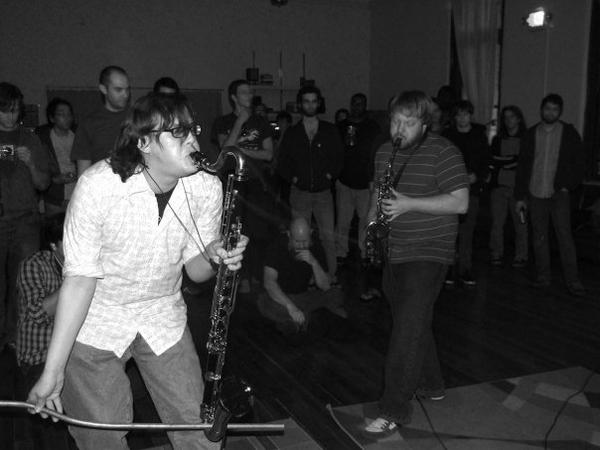
Interview with Violet

Violet (aka Jeff Surak) is a busy man.  He performs solo and in various of combinations with other sound artists, promotes monthly (at least) events under the Sonic Circuits banner, runs experimental imprint, Zeromoon, and hosts the annual Sonic Circuits Festival over the course of a week.

Exactly how many projects are you involved in; both recording and/or performance?


I've been involved in many.  Currently, the only active projects are my solo work under the moniker, Violet, and my occasional trio with Janel & Anthony.  Violet has been around since 2002, and arose from the ashes of a duo project that I was in called, V.  Violet is composed and improvised at the same time.  Whereas, Janel & Anthony & Violet is total fuck-it-all pure improvisation.

Each year, you run the Sonic Circuits Festival, and promote several shows under the SC banner throughout.  How did Sonic Circuits get started?  Was it just you, or a collective of people?


Sonic Circuits was started by the American Composers Forum as a touring festival concept to each of their local chapters.  The DC chapter did the first one in August 2002, and I was invited to perform at it...and I did my first solo performance ever after years of performing in a group of some form.  The ACF supported the festival for a few years, then stopped the program, but the DC chapter kept doing it each year.  I got involved with organizing in 2005 and then took over the helm.  It's always been managed by a group of people, and now more people are involved, but I pretend to be the director/programmer/head honcho.  Doing shows year round didn't start until Summer 2008, and they quickly proved to be real popular, so I've kept doing that as well.

How has Sonic Circuits grown from the initial concept/idea?


Originally, it was focused on electronic music, and the festival grew and shrank over the years.  When I got involved I expanded it to cover all forms of experimental music, whatever they may be.

When did you first begin to explore experimental music?  What was your first exposure to it?


I listened to "weird" stuff ever since I was a little kid, and began playing with tape recorders when I was 7.  I released my first tape when I was 15.  My taste was highly refined at a very early age, and I still listen to the same stuff.  I never had that awkward pop music phase that people tend to go through before they discover real music.  For me, it was Zappa, Beefheart, The Residents, Varese, Black Sabbath right from the get go, and then other obscure stuff as time went on.  I pretty much researched stuff at the local library and listened to psychedelic rock records and read all the rock books in search of the weirder stuff...and one reference would lead to another.

What do you get from abstract/avant forms of music and sound that you don't get from traditional music?

I think avant forms of music explore other aspects of sound beyond the tyranny of melodies that you can hum and beats that you can dance to that control popular music.  So, it's a hell of a lot more interesting and better for you as well.

You have lived in other countries, correct?  How did you come about living in the places you have?  What are some of the differences that stick out to you most about living, and performing, in other countries versus in the US?


I studied abroad so that's really how that happened.  And, in case of my time in Russia, I hung out there for quite a while as well.  In general, there is more support for experimental music in Europe, in terms of funding and audience, and more women involved as well.  Venues are better, and it seems like every little village has their own festival.  Of course, there are regional differences...

How do you manage to bring in such a wide array of performers from other countries?  By "manage," I really mean AFFORD!


It's all voodoo and Kabuki dancing.  Really it all depends on each case.  When there is an opportunity to present a particular artist, I try to take advantage of it.

Tell us a little bit about the Zeromoon label you run.


Zeromoon began by chance in 2000, it was really supposed to be a website just to archive all my old work since the 1980s, and somehow I ended up putting out a CD-R of new stuff, and then it snowballed from there.  Now, there are over 100+ releases of archival and new material from a variety of folks, most of it free to download in FLAC and MP3 formats.

Put on your promoter hat.  What does this year's Sonic Circuits Festival have in store for us?  Dates/times/website(s)?


It's all on the website www.dc-soniccircuits.org.

Interview with Soft Pieces

At the 2009 Artomatic festival in Washington, DC, there were many great performers at the Sonic Circuits showcase that day.  However, the one stuck out to me the most was Soft Pieces (Zach Mason).  He wore a solid black, form fitting cloth mask over his head with no shirt on.  While he made an incredible atmosphere of thick noise and sound creation/destruction, a group of people drew on his octopus tattooed back.  It was audibly and visually entrancing.

I have had the pleasure of getting to know Zach, and share stages/floors with him over the past few years.  So, it was inevitable that an interview with him was to end up on this blog.

You record and perform under the name, Soft Pieces.  What is the meaning behind this name?


I've never been good at focusing on one thing at a time.  The name came from a series of sculptures I did maybe 10 years ago.  They were wood, covered with paper mache, painted pink.  They looked - to, at least - like giant pieces of Bazooka gum and I ended up calling them "The Soft Pieces."  Around that same time, I was going through a long spell not playing live.  So, when a friend who booked shows asked if I wanted to be on a bill, I needed a stage name.  I wanted something new and Soft Pieces seemed like a good fit because of all that it can convey - vulnerability, modularity, etc.

I have heard several recordings of yours which tend to range from quiet, shifting ambience to harsher, repetitive noise, to more abstract sound manipulation.  How do you describe your sound, and presentation to someone unfamiliar with what you do?


That's a good question!  I'm really lucky to have a lot of supportive friends who are interested in what I do, but only a few of them would actively seek out noise music by other people.  So...this isn't exactly answering your question.  I always think of other people as part of the recording and performing processes.  Not in a self-censorship way, but in a none-of-us-exist-in-a-vacuum way.  This stuff, the Soft Pieces stuff, is being explicitly created to be shared with other people, right?  There's other audio stuff or visual stuff that I do that I don't share, or I only share with a specific group of people.  But, this is meant for everyone.

There are moments or passages that might try the patience people, but I'm always hoping that people will trust me not to do anything at their expense.  Do you know what I mean?  I take that record/listener and performance/audience relationship very seriously.

And, I really believe in the power of sound.  I really feel like there's an inherent excitement in sound and if it's shaped right, it doesn't matter what kind of sound it is, there's something there, in the sound, for anyone who's able to take a moment and listen.

Live, you are definitely one of my favorites to watch perform.  I love the mix of performance art with what you do.  Have you always tried to incorporate this into your performances, or did you start out more basic?


Thanks!  I started out like most people; I was in bands in high school and right after.  When the last band I was in...we were all going to move to a new city together, I backed out at the last minute.  When that ended, I still wanted to find a way to make music with a lot going on, and do it in a live, dynamic way.  It started out much more repetitive and noodly than it is, now.  I was mainly playing bass over guitar drones and arpeggiated synthesizers.  Even when I eventually got away from that model and the music was almost exclusively improvised, it felt really safe and unfulfilling.  For me, playing music in a very sedentary mode...like, hunched over a bass guitar or synthesizer or whatever.

I don't get nervous about that, at all.  And, I get nervous about pretty much every other aspect of day-to-day life.  So, not being nervous feels unnatural, I guess?  I always want to be a little afraid that things won't work.  That's part of it.

The other part of it gets back to what I said about earning trust.  I want people to enjoy and remember my performances.  That's really important to me.  I want it to be something that they, hopefully, haven't seen or heard before.  And, that even if it's not their normal thing...the music's too atonal...they opt out of participating in the interactive bits...I hope that they have a unique experience.  And, I want to explicitly say that I've played for a lot of really patient and curious audiences who gave me a lot of room to move, in a creative sense; and that's huge.

How do you decide what approach, sonically and visually, to go with for each performance?


My brain constantly makes associations.  So, even if it doesn't make sense to anyone else, the sounds at a specific show absolutely go with the visuals at that show...to me.  I can't always explain it, and I don't usually want to explain it, honestly.  Like, I'm very much against naming my tracks, at the moment.  I feel weird telling people THIS IS WHAT THIS IS ABOUT; THIS IS WHAT YOU SHOULD THINK ABOUT, RIGHT NOW, AS YOU HEAR THIS.

So, while I always know why one thing goes with another - there's always a meaning, to me - I hope that other people can find what those things mean, together, to them.

Have you ever had an audience member react negatively to a performance?


This is pretty much a guarantee of future violence, but, no, I've been very lucky.  I am actively trying to bring a collaborative, instead of combative, mode to the shows, so hopefully that comes through.  Although, now that I've said that, I feel like the woman you know, who had a nightmare about me kidnapping her and wrapping her in a Slinky...that qualifies as a negative reaction, right?

What do you have lined up as far as recordings/performances?  And, where's the best place for people to look to find out more about you?


I just released a CD-R by Beruhrung - http://www.softpieces.com/txt/?p=516 - my collab with Gary Rouzer of Nine Strings, Amplified Textures, etc.  Really proud of that record.  The best place for information is www.softpieces.com.  I've got a huge backlog of live Soft Pieces recordings - audio and video - that I need to get online.  Look for that, soon.

Interview with White Suns

The Pyramid Atlantic is an independent art gallery (visual and audible) in Silver Spring, MD. DC's Sonic Circuits org frequently puts together lineups of forward-thinking sound/noise artists at the space each month. This is where I first experience Brooklyn, NY's White Suns, and their pure, unrelenting furry of buzzsaw drums, guitars, electronics, and screams. It was beautiful.

With each release, White Suns continue to expand into more far-out territory incorporating improvised noise with their well-honed assault.

Guitarist/vocalist, Kevin Barry; guitarist/electronicist, Rick Visser; and, drummer/electronicist, Dana Matthiesen were kind enou
gh to answer some questions.


Let's start with a little history. How did you guys get together? Previous musical background?

Dana - We all grew up in the same town and all began playing music in high school. I knew Kevin was into noise/no wave music, so we ended up fucking around in m

y garage and eventually forming a band. Rick joined later, but he and I had been musical comrades and collaborating in some form for an equally long period of time.

Kevin - We gravitated towards each other because we all possess the ability to utterly offer ourselves up to the experience of making sound.

The first time I saw you guys play was at The Pyramid Atlantic art space in Silver Spring, MD. I've heard a lot of noise based performances there but nothing as intense as you guys. Does it seem strange doing what you guys do in an art gallery/s

pace?

K - I, for one, have enjoyed playing in "fine art" environments because it invites a different type of criticism. Rather than focusing on how well we can (or can't) play our instruments or whether there are any hooks in a song, I hope the audience might be considering the more formal aspects of our music - structure, space, texture, etc. These are the things we think about when we write the songs.

D - Ditto. We rarely get the opportunity to play that sort of venue and, even though it was an uncommon and somewhat odd experience playing for a mostly-seated, older crowd at Pyramid Atlantic, I think those people can get into the abstraction we bring to rock music.

Rick - It doesn't seem strange doing what we're doing anywhere anymore, and playing in galleries allows us to experiment with more improvisational material, or in the case of Pyramid Atlantic, the long form song. The audience is generally more interested in seeing something abstract or experimental and also more attentive.

You guys have a great mix of noise and experimentation mixed with fast, raw...I don't know.hahaha, punk, maybe? It's a beautiful thing! Has your variety in sound opened more opportunities for you guys to play different types of shows, or have you found it harder for people to digest since White Suns don't seem to fit any clean, neat musical template?

D - It's weird. We don't find much in the way of 'sister' projects where we live, but it hasn't kept (a handful of) people from liking what we're doing. We typically play with bands that verge more toward straight-up punk or rock than I identify with, but the crossover potential in terms of the audience digging less tonal or linear music is totally out there. People just aren't doing it.

K - We certainly don't get stuck playing the same bills all the time, which is great. Our lack of an easy genre reference hasn't caused any problems.

R - We play noise shows where we're the only band with a drummer and punk/hardcore type shows where we're the only band without a bass player, playing songs longer than two minutes. There are always some people that are into it and some people that aren't.

"Mourning Chamber" was one of my favorite releases of 2010, and resembled more of what I experienced seeing you guys at Pyramid Atlantic, and at DNA Test Fest, last year. However, I just listened to "Cavity," recently, and was caught off guard by you guys letting more space into the songs with more sound based experiments. What influences/inspiration do you guys bring into the fold that inform White Suns' sound?

K - The three of us arrive at White Suns from different musical trajectories. The most inspiring thing I have experienced recently was a book of selected poems by Anne Sexton.

D - My aesthetic tastes generally revolve around European high modernism, punk rock, conceptual art, and their offspring. Favorites include Beckett, Xenakis, and Harry Pussy. I also spend a lot of time reading philosophy and logic/mathematics books, so it shouldn't surprise anyone who knows me that my approach to music is generally more inclined to formal and technical manipulation. I think I'd like our band to get to a point where I'm only incidentally playing the drums, but we're a ways off from that right now.

R - I have come to prefer the songs with more space and less of a pounding straight ahead rock vibe. It allows us to explore sounds and their interaction with an emphasis on the sound itself, as opposed to burying it in a punk song. Lately it's been all about sound and not composition for me. Or...sound as composition. I agree with Dana, perhaps one day it will all be incidental.

White Suns have a new album coming out on ugEXPLODE, "Waking In The Reservoir." How did you guys get hooked up with ugEXPLODE? And, what can we expect from "Waking...?"

K - Weasel Walter, who runs the label, asked us to play a show with one of his projects. He was enthusiastic about us and offered to put out a record. We were overdue for one and trusted his ethical business practices. You can expect 7 well-recorded songs - all but one have vocals.

D - Most of the credit must be given to Weasel for actually giving a shit about us. As for the content, there are a couple things toward the end that will remind you of "Mourning Chamber" and the sound experiments you referenced before; the rest is standard White Suns thrash-fest.

R - Lock grooves. Lots of lock grooves.

Interview with Chris Corsano

I am an addict. Chris Corsano's work, solo or in dozens of dizzying collaborations with such names as Paul Flaherty, Wally Shoup, Death Unit, Thurston Moore, etc, etc, etc. continues to provide me unlimited inspiration. Corsano is of a rare breed of musician/artist who just knows how to let it flow out of him, unfiltered, with an intense focus. How many drummers do you know that have the balls, and ability to drop jaws, to tour solo? Yeah, me neither.


How did you first get started in music? What was your first instrume
nt?

First was some piano lessons when I was young. It was a battle of attrition between my laziness/zero-practice regimen versus my mom's heart-felt desire for me to do something other than waste my youth on video games. The second time she tried to get me to take lessons, she dug up this guy who, to my 12-year-old eyes, seemed like he was pushing 90. I think his bread and butter was Americana (e.g. "You're A Grand Old Flag"), so when I said I wanted to learn something a little more modern he went straight for Billy Joel's "Piano Man" and Bon Jovi's "You Give Love A Bad Name." Shot through the heart! A year or so after that, I got a set of drums. My older half-brother had been playing since before I was born, so I guess it was a natural thing to want to do.

Growing up, what music/artists had the biggest influence on you?

When I was in my early teens Hendrix was probably the biggest. Also Led Zeppelin, The Who, Cream...basically anything on the classic rock radio stations that had busy drumming. When I was about 16, my sister's boyfriend hipped me to the minutemen. That was lif

e-changing. My brother turned me on to Beefheart and Ornette Coleman at around the same

time. I can go back to any of those three and still have my mind blown by something I'd missed on the 8,000+ previous listens.

You have played with some incredible musicians. How did you first get into hooking up with these artists?

I worked for Byron Coley for a good long while. He introduced me to Thurston and also Michael Ehlers (Eremite Records) when Michael was doing a concert series in Amherst, Mass. In exchange for putting up posters around town or doing door, I saw concerts for free. That's where I first heard Flaherty-Colbourne, TEST! (Daniel Carter, Sabir Mateen, Matt Heyner & Tom Bruno), Harry Pussy, Joe McPhee, William Parker, Brotzmann, No Neck Blues Band, and on and on. I asked Paul (Flaherty) and Randy (Colbourne) to play a show I was setting up. I gave Paul a copy of a record I did, and maybe a year later he asked if I wanted to jam. Things

developed from there.

Who are a few of your favorites to play with?

That's a tough one. It's like putting "thank you's" on a record, you're inevitably gonna leave some people out and end up short-shrifting people. Maybe instead of talking about the best, I'll talk about the worst. Years ago, I answered a flyer put up by somebody who wanted to do some kind of rock/free-jazz amalgam. It listed Sonic Youth and maybe Ornette (this was a long time ago, so my memory's hazy), among a lot of other stuff, as influences. So I read it and my mind saw FREE in big, bold letters, where I think the other people who turned up saw JAZZ or ROCK or I don't know what. It was an hour and a half of mismatched aesthetics hopelessly grinding into each other. At one point the Jazz-with-a-capital-J keyboard player started snapping his fingers at me so I'd do better job of keeping the beat. Awkward.

Aside from playing alongside traditional instruments, you’ve also performed with those in the outer realm of sound and noise. How do the two experiences differ for you as a drummer?

No categorical differences, really. Everybody's approach is different--even from saxophonist to saxophonist--so it goes person to person rather than instrument to instrument. One thing that can quickly differentiate certain players from others is the use of heavy amplification. There are different approaches/responsibilites that go with being the loudest motherfucker in the room or the quietest.

Do you get more a fulfillment out of playing with different types of musicians versus having a straight “band” per se?

I like to do both, so I don't see it as either/or. It's been great developing something like the Flower-Corsano Duo over a long period of time. But I also really like doing one-offs with new musicians. Some of the things (techniques or whatever) that develop out of one playing situation, I'll carry over to others. Hopefully, everything influences everything else for the better.

This past year, you released and album, and toured, with Rangda. H

ow did you land that gig?

That band was Ben's idea. I'd played with him a bit on some Six Organs sho

ws and one record. He knew and had already played with Rick, so he wanted to get the three of us together and see what happened.

It seems like, aside from Rangda, that you primarily improvise when you play (and maybe even with Rangda). Do you prefer improvisation versus writing?

Short answer: I prefer improvisation. Longer answer: I prefer whatever approach feels like it has the best chance of creating something worth people's time. With Ben and Rick, those guys are natural born riff-writers, as well as improvisors. That's not something that's in me like it is them. So Rangda is basically me riding their songsmith coattails. There's also im

provisation w/in Rangda's songs, though. I don't think I could hang for too long in a band that was all-composed at this point.

You have performed a good bit , solo. Does performing solo allow you a freedom that you don’t get when playing with others?

I think it's more about creating a different context than looking for missing freedom. I try to find people to play with where I don't feel restrained. In a way, I feel less free on solo sets. When it's solo, it's all on your shoulders--when you stop, it stops. And if it's not happening, then there's nobody else that's going to come to the rescue.

Interview with Hunted Creatures

What started as a solo project for Pittsburgh, PA's Ryan Emmett has evolved into a group of kindred spirits whose varied instrumentation and soundscapes express the fragility of human emotion and the purity of sound as an art form.

Mr. Emmett was nice enough to let us look behind the curtain of Hunted Creatures.


How did Hunted Creatures start? I know that you and Reeves had/have Cottonball man going.

I've been performing solo stuff since my first real band, Pi Equals Three, broke up in 2003 or so. At first I went under the unfortunate name Droopy Septum but later changed it to Hunted Creatures and started exploring different ideas. It's experimental music by nature and to avoid getting caught in a rut I wanted to give up full control of the project and turn it into a band so that my ideas could mingle with the ideas of my friends as well. Cottonballman Enterprises is reworking the business model. We aren't sure about the future of the company since CEO Reeves Smith relocated to Oakland, California, but we may hold a Founder's meeting with our top investors soon.

The first HC material seems more straight synth-based ambience, whereas "Strobe Flowers Bloom" mixes in a more noise layered approach. Ryan, has the change in sound been the result of adding more members to HC?

Actually that track, "Strobe Flowers Bloom", was a piece I put together several years ago. I still enjoy it, so versions of it creep up on various releases from time to time. The current sound has certainly changed because of adding new members. There will be more solo

material being released soon probably under my own name, Ryan Emmett.

One of things I really enjoy about HC is whether the music is layered in soft textures, or harsher tones, there is still a sense of fragility to it. "Hunted Creatures," as a name, also gives me that feeling. So, what exactly is overall thought process and feeling behind it?

I love the sense that something could fall apart at any minute. I can't say much more about it, but your observation is the best compliment I've heard since being called "a fucked up Pink Floyd on coke" or something like that by an old biker dude in Athens, OH. Maybe Amy remembers the exact quote.

Amy: It was "Y'all sound like Pink Floyd on crack."

From the live sets I've heard on your bandcamp site, and live video online, it seems like you guys venture a little more into sound art territory with various instrumentation, objects, and methods. Is this a conscious decision to make a the live experience different from the recordings?

It sort of happened that way. It's conscious for me, to have some correlations yet remain separate things, but perhaps the other members would like to try to have them more related. We'll see what happens. I suppose my logic is that once something is on recording one can always go back to it and listen, whereas a live experience is different. Acoustics in the room are different… the whole thing is different by nature and I don't personally mind that.

The DVD that you guys released this Fall had a lot of interesting ideas; a lot of visual and sonic textures with each of the four pieces. Do any of you guys have a background in film design?

I went to school for Printmaking, but the entire time had an interest in other forms of art that weren't so traditional. 1960's modernism, Dada and the whole NYC loft scene, La Monte Young and structuralist film all interested me in conjunction with my involvement with punk and hardcore. I have always loved film. Anthony McCall's "Line Describing A Cone" blew my mind as a senior in high school. For me it was about getting rid of boundaries. You can use anything and combine anything to make enjoyable art. I think more bands should release DVDs as their official music releases and more people could have their TV audio connected to a nice sounding stereo.

The piece, "A Place To Stay," from the DVD is definitely my favorites in both sound, and the footage you guys used; particularly, the giant windmills in PA. I drive by those on the way to the show in Pittsburgh, last May. There's something monolithic about those things. Why did you guys focus so much on those structures in the piece?

Actually, those windmills were filmed in Illinois or Indiana I believe. But I know the ones you are talking about in Pennsylvania and they look amazing up on the hills as you wind around the roads. My process for making a lot of my art is based on chance and control ratios and boundaries. Oftentimes I will make a collage by limiting myself to a single magazine and creating something based on the images that lay within. With film it is similar. The end product is imagined but not planned. So I took a bunch of various footage I collected while traveling and then forced myself to create a video piece based only on those particular images. The whole time I was fairly blazed and just sifting through all this footage trying to make thematic, chronological and visual connections to make some sort of sense out of the arrangement. It ends up pretty abstract but it is through a process that I enjoy quite a bit.

What do you guys have coming up this year?

Hopefully, some releases on Pittsburgh based 800 Wild, Travis Bird's Notice Recordings, Baked Tapes and perhaps splits with Casual Male and Stone Circle. We're aiming to do a spring midwest tour, play more local shows and explore more green pastures. If anybody wants to release a 12" record for us please let me know because my label Dynamo Sound Collective can't afford to right now!

Interview with Borborites

Fairfax, VA's Borborites have become one of my favorites in the DC area improv scene. Mixing elements of jazz, folk and sound artistry, this trio continues to get more impressive with every performance. The homemade cassette tape placed in my hand by a drunken Andrew McCarry at a recent show only further emphasized the fact that these guys are only going to get more impressive. This interview was conducted with Andrew and Chethan.


Borborites were considered to be dirty, nasty characters. So what made you guys decide to name yourselves after them?


Chethan: For a while, we were calling ourselves Borborygmi. We liked the sound of the word and, truthfully, it seemed to be an accurate description of our sound at the time. I think that led to us discovering who the Borborites were via occupational boredom and google-based procrastination. Amidst frequent line-up changes and confusion over what the band's purpose was, we toyed with the need for an alternat

e name. I'm not sure it was even a conscious decision on anybody's part to formally change our name, but I think once the name "Borborites" ended up on concert flyers and uploaded live recordings, we realized that the new name had already stuck. I think "Borborites" is an equally fitting name for us, anyway. All of us involved kind of rightly or wrongly view ourselves as lowlives of some sort. We are dirty, nasty characters, and we may not be particularly proud of that fact, but we at least take solace in accepting it and then using it as an excuse to justify our behavior.


How did you guys get started? Seems like a pretty unique grouping of personalities.


Andrew: It's Chethan and I, and whomever else we've conned into the


ride. We've been good friends for about 10 years and have been making a racket together on and off for most of that time, but we got more "serious" about it after college when we lived together in Fairfax. Various friends and guests have passed through the band. We met Matt over some poppers at a show at record and tape exchange and became close quickly. People with niche interests tend to seek each other out, especially in


extremely square places.


You guys have a great sound as a group. There's some folk, psych, rock, and noise tendencies in there. Do you all have any real sort of direction you prefer as a group, or just completely fly off-the-cuff with each performance?


Andrew: We'll have a little idea based on what equipment we brought/is working at each session, but for the most part it's completely free. For now, Matt's staying on drumkit and we're exploring that sound after going for most of our first year completely anchorless. We don't play the same thing twice, and if it sounds too similar it's kind of a disappointment.


You also started Avant Fairfax. What is AF, and what is the goal? Upcoming shows for AF?

The idea for Avant Fairfax came about around November 2008, with the first event happening april 25 2009. Avant Fairfax is a part of the month-long Spotlight on the Arts festival. This is how we get access to the old town hall and the PA we use and about 1/4 of the funding comes in the form of grants from the Commission on the Arts. Joanna Ormesher, the chairwoman of the whole deal is a coworker and close friend.

Anyhow, when Scott Verrastro moved out of DC, we lost the best booker in town. I wanted to have that space, that energy back. Shows at his house 611 Florida or at Warehouse or Velvet Lounge were some of the best nights of music anyone could ask for, truly mind-expansive experiences. (when i was in highschool i essentially thought that the music that came to town was either at 930, black cat or one of the dad-rock venues like birchmere and state theater and that the mythologized days of dc punk underground is way dead.) The bands he plays in, Kohoutek and Kuschty Rye Ergot are my absolute favorite live acts. The guy has fantastic taste, and I work very closely with him to curate the events, as this is something I do a couple times a year, and he does it several times a week. 

So with Avant Fairfax, I just wanted there to be something cool to do in this town, (unfortunately, the GMU crowd heavily favors wack shit, but we're working on them) and to bring like a basement show vibe into a historic building, big sound, good beer, and a well curated line-up. It's not like we sell tickets, it's a peer pressure donation system where you pay based on your ability to. Like, I've been to house shows and while it says $5 suggested donation, I'll usually give like 15-20 bucks and bring some beer. It works out often in favor of the artist when it feels like a comfortable hang out and not a money making venture. Sure, I sell beer, but all profit on that goes to the artists. And I sell better beer than is served in fairfax bars and it's cheaper.

The festival is coming up again this year at old town hall, Saturday April 23rd, and we'll have Friday and Sunday shows too. There are some really great bands and solo artists bringing a diverse palate of sound. I am waiting on a headliner's confirmation before I make the big public push for attention. We're also going to be having several benefit shows in advance of the fest, so keep your ear to the ground.


Interview with Wasteland Jazz Unit


Over the past two decades, I have had the pleasure of seeing many concerts of varying styles. Sonic Youth (Dirty era), at the time, was the loudest live experience for me. I was a teenager attending a Lollapalooza concert in Charlestown, WV when I first saw SY. Through the mountainous PA system, we all had our audible palate cleansed that night. Years later, I still remember a girl with her hands over her ears stumbling through the crowd away from the stage.


Then, one night, I saw two guys set up in an abandoned bank turned DIY space in Baltimore, MD. The setup seemed simple: two guys, two horns, a stack of amps each. A short greeting was followed by the loudest set I have ever heard. Even with earplugs, it was intense. Both flailed back and forth with intent like they were trying to force their lungs through their instruments. Wild combinations of notes and sounds, combined with feedback, left the faces (and ears) of the audience stunned.

Fifteen minutes into the set, one of their amps seemed to blow; leaving a constant ring like a heart monitor flatlining. The two stood facing eachother with their eyes closed. Even with amplification gone, Jon Lorenz continued to play acoustically. Jon Rich decided to riff around the feedback, as if it was part of the set. I was sold.

Listening to Wasteland Jazz Unit play, and the name itself, I feel like you guys would be the common "jazz" sound for post-apocolyptic times. How did you guys develop the style you play?

John Lorenz: Throwing contact mics in horns, turning our amps to 11, and an obsession with biting reeds and feedback tones. Not really going for post-apocolyptic or anything just playing the music we wanted to hear.

John Rich: No heads.

Do you do much in the way of manipulating your horns through effects pedals?

JL: None at all. The only effects we use are the ones already on our amps. Distortion, basically. Pedals can take away from the focus of things. We've heard a lot of jams completely ruined because of unnecessary effects. Either just awful sounds or too much focus on the "effects" than the sounds being created. Some people have this idea that "experimental music" is all about manipulating sounds but ya gotta make interesting sounds first, and then think about manipulating them. So yeah from the start we just said "Fuck using pedals" and focused more on the initial sounds we were making. I did just buy a volume pedal though so WJU officially has one pedal.

JR: No effects. Keep it simple, keep it raw.

How did you guys meet up, and start WJU?

JL: Me and John had met on several occasions over the years at shows and what not. At some point, we both figured out that we both played horns and were into free jazz and what not so it just made sense. John came up with the name before we even played together. When we first played together I showed John this idea that I had been messing around with using contact mics inside the horns and John said "yeah let's do that and turn our amps up all the way." So yeah it basically developed from that. I think our first show was in early April of 07 with Ryan Jewell and George Steeltoe Ensemble.

Do you guys come from any kind of a traditional jazz background?

JL: Not at all. I have no training what so ever. My sister was in band in high school and dropped out. She didn't need the sax anymore so I decided to take it back to college with me even though my parents wanted to sell it or something. They actually were kind of mad and wanted me to give it back but once they found out I was actually making "music" with it they were cool.

JR: I played clarinet in elementary and junior high band, but that's the extent of it. Don't really remember anything except how to blow "properly" but I guess that's all that really matters.

So, what kind of background do you guys come from?

JL: I started playing guitar when I was 13 or so. Started playing sax when I was 20 maybe. Grew up on Sonic Youth and Pavement and the typical 90's indie rock stuff. Got more into free jazz stuff when I started playing sax. Heard Brotzmann's "Machine Gun" and that pretty much explains everything.

JR: Can't remember... listened to a lot of Neil Young.

Live, you guys have a blistering sound; volume and chaos. What effect does your music have on you in a live setting? What impact are you hoping for on an audience?

JL: Our live sets are usually pretty chaotic but sometimes our sets change according to the room or the vibe. Live sets are fun cause people actually get to see the physical side of things so we try to play that up a bit more than we might on our recordings. We want it to be a physical experience. We want people to feel our hands hitting the keys, to feel our teeth vibrating against the reeds. That sort of thing.

JR: I just want to make people happy and enjoy themselves.

How do you identify yourselves, categorically? I've heard you described as "Noise Jazz," "Death Jazz," etc.

JL: I probably wouldn't even use the word "Jazz." I think we try to be as far away from the word "Jazz" as possible but that obviously comes with the territory of playing horns which is why we used it in our name. We might as well just play along. Yeah, we're a "Jazz" band.

JR: Death and noise make us sound so negative. I think of our music in a more positive way. Full of joy and happiness.

How often do you play in front of more traditional jazz crowds? You recently played a jazz fest in DC. What was the reaction like there?

JL: I think that was pretty much our first time playing for that type of crowd. In Cincinnati, we for the most part only play gigs that we put on. There isn't really much of a freaky jazz scene here. The New Atlantis Fest in DC was a lot of fun. I think we cleared at least half of the room but the people that stuck around we're very excited about what they heard. We didn't make it the first day but we heard the same thing happened for Weasel Walter's set with Darius Jones and Tom Blancarte. A good chunk of people didn't like it but the people that did like it really liked it and bought a lot of merch and stuff. I think to certain people in that "Jazz" scene bands with high energy are a breathe of fresh air.

JR: DC was a lot of fun. I never want to bum anyone out and we never really get asked to play jazz gigs in town. I think when people hear us they immediately know what they're getting into and will either stay or go. I guess it's nice to have a "yes or no" sound.

What is your involvement with the Art Damage Lodge? Will you give us a little background into the venue?

JL: We both run the space. We started it in October of '07. It's in an old Masonic Lodge. The name comes from the Art Damage radio show, which we now host, that was started here in Cincinnati, in 1985. The show was a big influence on us and has a lot to do with the history of experimental music in Cincinnati. We definitely wanted to keep that history alive and have our own place in Cincinnati to keep the weird music alive.

For those who don't know, Jon...you run the site Wounded Slug. Give us a little background on the site.

JL: Wounded Slug is a blog that I do that focuses on weird music of Cincinnati. I mainly post videos of shows at Art Damage Lodge and around town but I also post downloads to out of print records, old footage of stuff, weird Cincinnati related videos. I started the blog basically because when I moved here I would hear about these weird 80's Cincinnati bands like 11,000 Switches and BPA and what not and could never hear them. Our local record store ended up putting out a compilation of some of these weird Cincinnati bands so I finally got to hear a lot of them but there is still a lot of stuff that people don't even know about so I'm trying to put everything in one place so anyone who wants to know has a place to find these things.

Is Rub Don't Blot still operational?

JL: Yeah. I guess. We haven't put anything out on it in a while but the label kind of exists as a name for either of us to use for whatever we wanna do. I'm actually gonna start a more serious label to go along with the Wounded Slug blog. The first thing I have planned is releasing a series of double cassette boxes with each including four Cincinnati artists. There are a lot of people in Cincinnati that don't really put out music so I'm trying to collect a lot of these people with some other more active names for people outside of Cincinnati to hear.

Jon, I know you have Early Tunnels going on, outside of WJU. What are some other projects you guys have going?

JL: Yeah I have Early Tunnels that I do with Pete Fosco. Me and John are in a group called the Ohio Unsemble with Ryan Jewell, Jason Zeh, and Matthew Reis (Teeth Collection.) That is more focused on the quiet side of things. We also do Wasteland Jazz Ensemble occasionally which is us and various other members.

If someone hears you, and wants to know about other likeminded groups; what are some recommendations you make?

JL: Well, I think the obvious answer to this is Borbetomagus. Antoine Chessex's stuff is along the same lines.

JR: The Crystals, The Ronettes and Shirelles

WASTELAND JAZZ UNIT